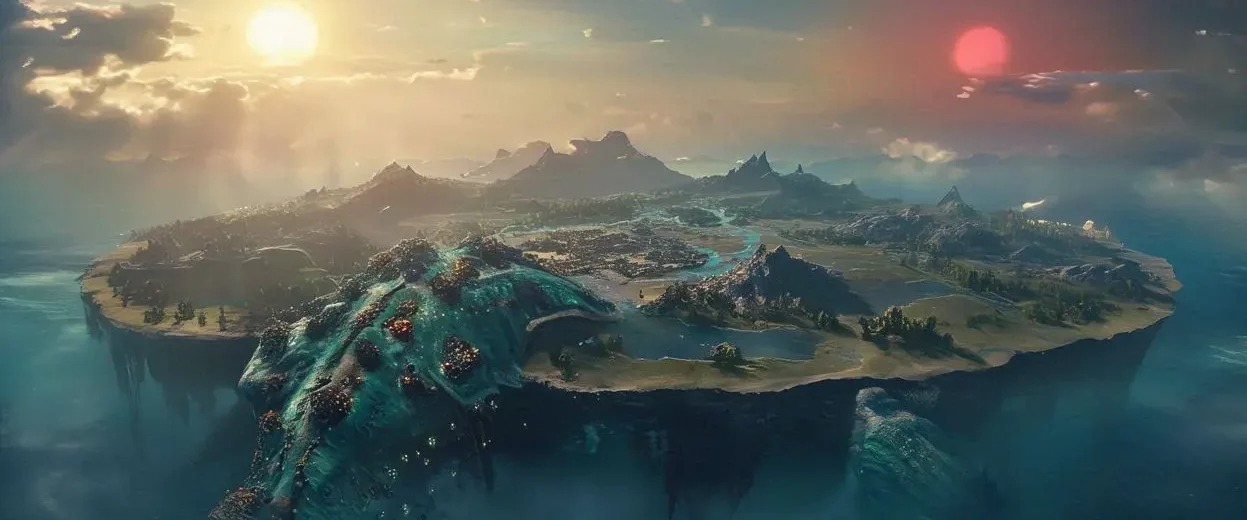
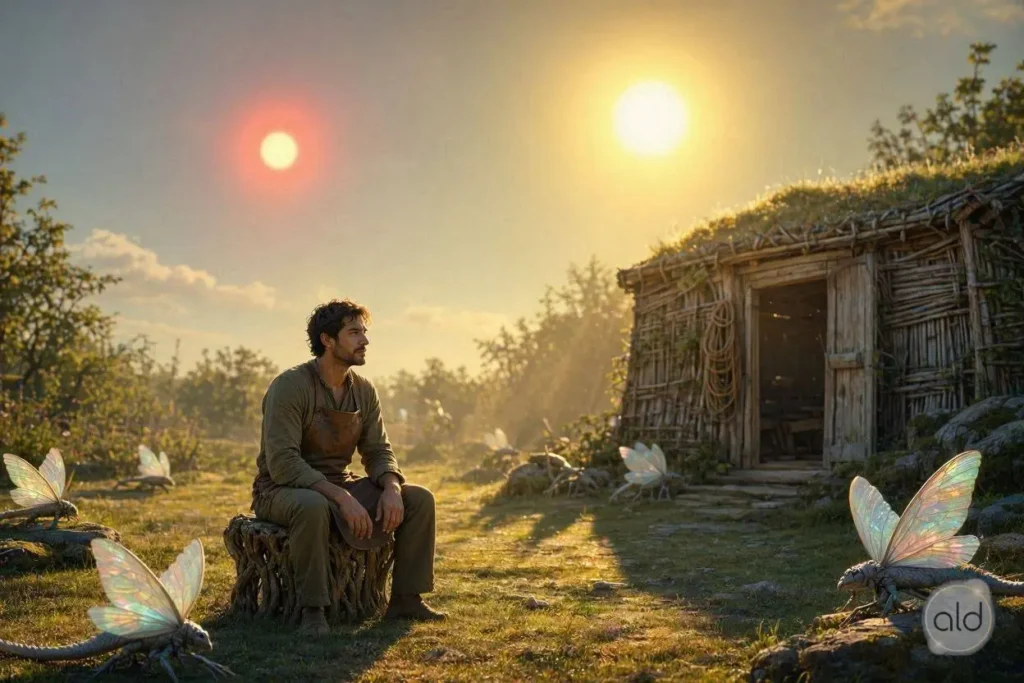
Far from the place where Yan‑Lum pondered the quiet constancy of the twin suns, something was unfolding deep beneath the earth—something invisible to the naked eye, yet no less significant. It happened in the heart of the Dark Cavern, a place so deep that the air was damp and cold, carrying the scent of ancient soil and iron.
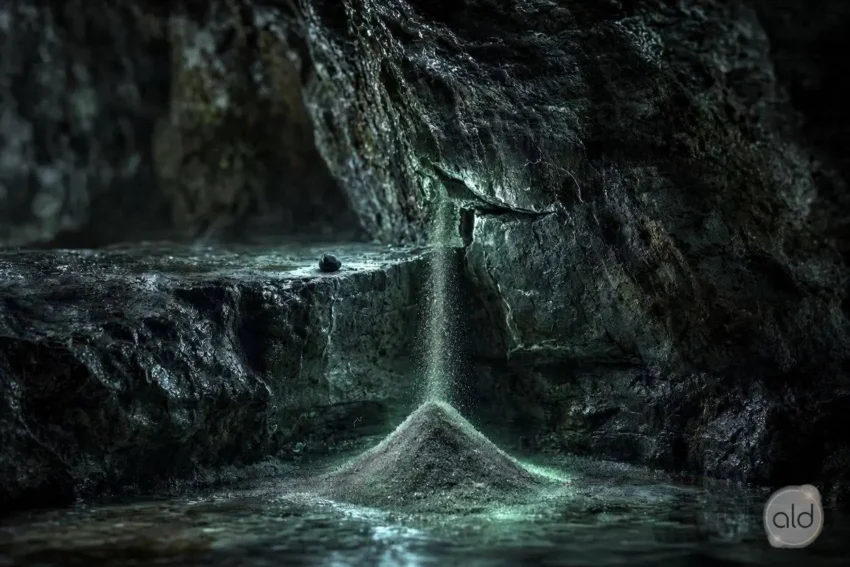
Deep within a wall that had remained unmoving for millennia, a small black pebble the size of a thumb loosened with a faint, barely audible crack. Through the opening that appeared—a thin, crescent‑shaped slit in the rock—sand began to pour into the cavern. Although the cavern was nothing but shadow, a hollow in the earth where not even the faintest daylight had ever reached, the sand seemed to glow with a soft, silver‑green haze. It wasn’t a reflection but its own cold luminescence.
In that endless silence, the falling sand sounded like the gentlest ticking of a clock that had just begun to measure a new kind of time. It formed a small, neat mound on the cavern floor, a cone reminiscent of an hourglass. Then, just as suddenly as it had begun, the flow of sand stopped. The slit in the wall vanished, sealed by the inner pressure of the stone.
The cavern fell silent again. The only evidence that anything had happened was the glowing cone in the darkness and a subtle vibration slowly spreading through the stone beneath it. A vibration that was not an earthquake, but rather a shift in the resonance of the world itself.
The question remains whether it truly happened, for no one saw it. But whether it did or did not, the balance had been disturbed.
And though the cavern sank back into its eternal stillness, it was no longer the same as before. The glowing cone of sand lay on its floor like a foreign body—something that did not belong here, and yet belonged more than the rock that surrounded it. Its faint luminescence reflected off the damp walls, drawing tiny, almost invisible shapes. If someone had stood there, they might have sworn those shapes resembled writing. Or perhaps just cracks. Or something in between.
The vibration spreading through the bedrock was not strong. It was more like the echo of something distant, as if a massive body had shifted far away and its breath traveled through layers of earth. And though it lasted only a few moments, it was enough to awaken something in the deepest fissures of the world—something that had slept for far too long.
The sand on the cavern floor trembled slightly, as if responding to something rising from below rather than falling from above. And then everything grew still once more.
The Dark Cavern returned to its ancient immobility. But the balance that had once held the world in a quiet, unwritten order had been disturbed. Not loudly. Not visibly. But irreversibly.
And so, while Yan‑Lum still gazed at the twin suns, contemplating their eternal constancy, far beneath his feet a story began to unfold—a story that was not meant to be seen. Not yet. A story born from a single grain of sand.