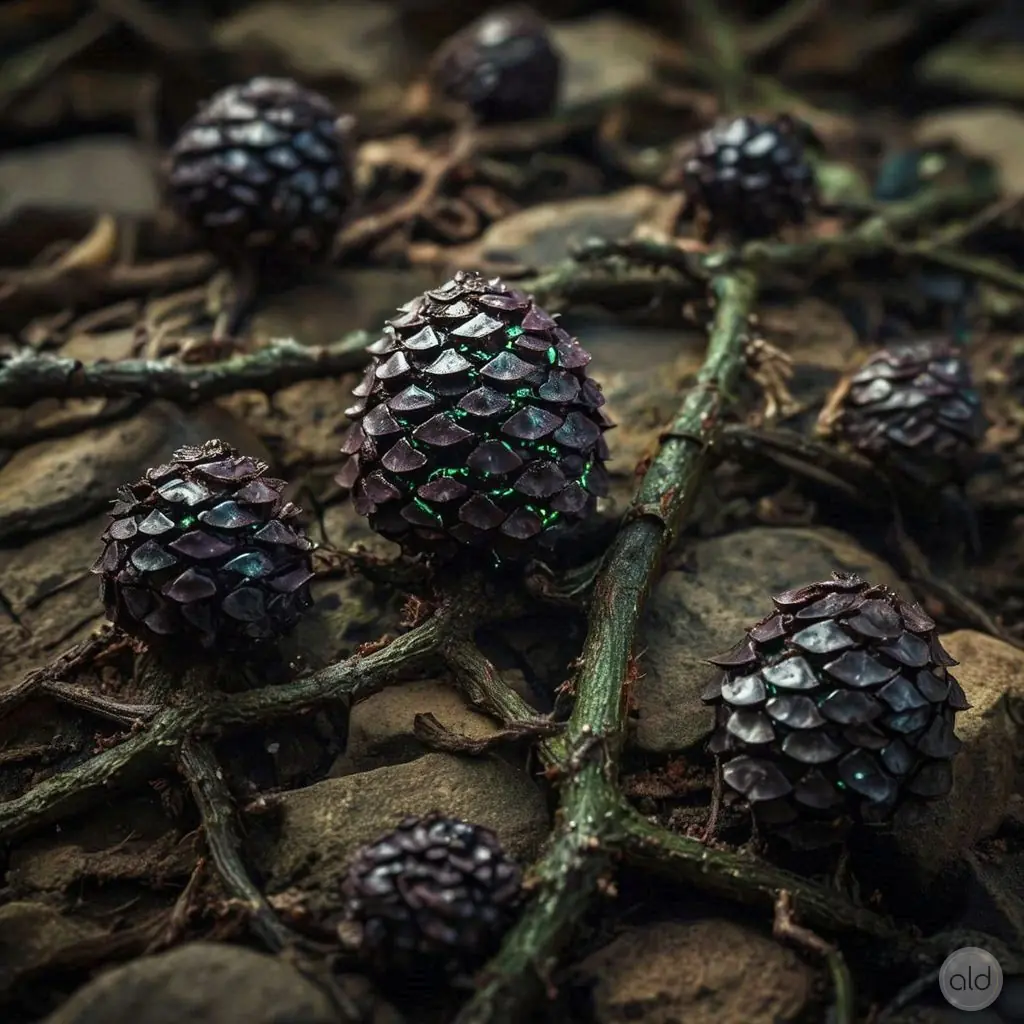
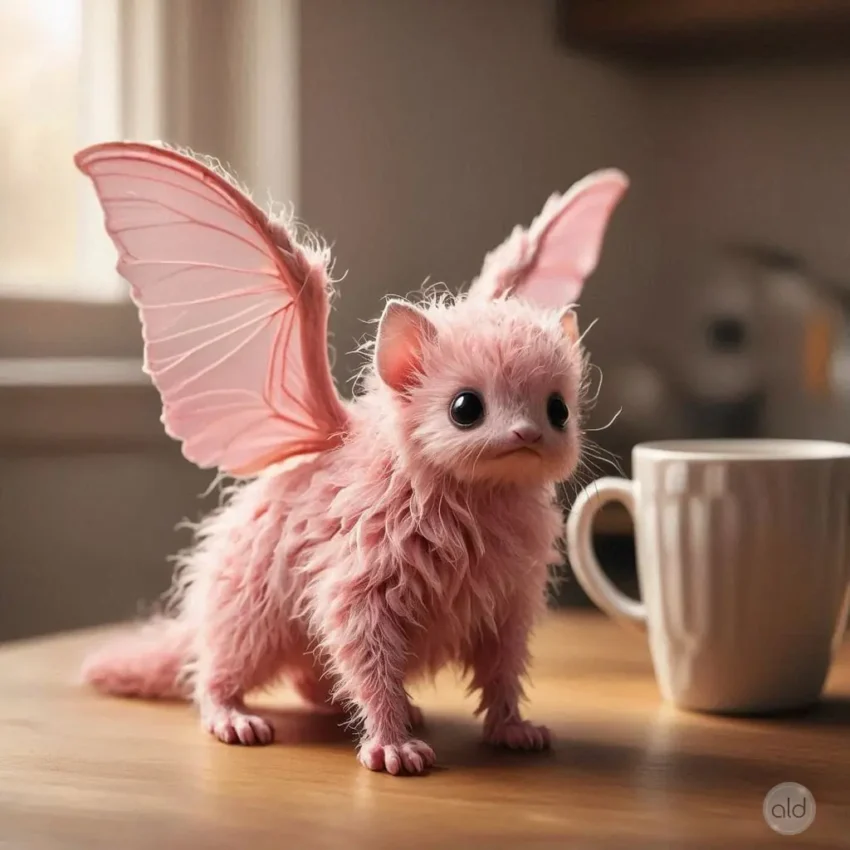
Ilaru is a small creature, roughly twenty centimeters tall, living in the warm regions of Tal’gorr. At first glance it appears to be a cute, harmless animal with soft pink fur and translucent wings, but its ecology is surprisingly complex. The pink coloration is not natural — it develops through long‑term consumption of Trharr’ka nectar, making Ilaru one of the few creatures capable of approaching this dangerous fruit without immediate harm.
🜂 Behavior and Temperament
Ilaru are curious, fast, and constantly in motion. Their behavior is a blend of:
caution (they are small and easily hunted),
boldness (they enjoy stealing small objects),
unexpected intelligence (they can remember complex routes and hiding spots).
Typical behaviors:
rapid wing‑fluttering when excited,
curling into a tight ball and freezing when frightened,
emitting a soft, high‑pitched “peep” when happy,
their fur briefly glowing a deeper pink when consuming Trharr’ka.
Ilaru are omnivores, but Trharr’ka nectar is their obsession. They can detect it from dozens of meters away and will take considerable risks to reach it.
🜃 Appearance
Ilaru look like creatures that belong in fairy tales, not in the harsh lands of Tal’gorr.
a body covered in soft, dense fur (naturally light beige),
pink coloration appearing only after consuming Trharr’ka nectar,
large dark eyes full of perpetual curiosity,
translucent wings with delicate veining, reminiscent of insects or tiny dragons,
small paws with sharp claws suited for climbing rock surfaces,
a short snout with an excellent sense of smell.
Although their wings may look comical, in the magical environment of Sionareth they are fully functional and allow short, rapid flights.
🜁 Ecology and Habitat
Ilaru live in the warm regions of Tal’gorr, especially:
in steam pockets,
along the edges of geothermal fields,
near Trharr’ka colonies,
in rock cavities and old pipe structures.
They are creatures adapted to environments where most animals cannot survive. Heat benefits them, and ground vibrations calm them.
Ecological role:
dispersing seeds of small plants,
keeping insect populations in check,
serving as prey for small predators,
helping spread pollen of heat‑loving flora.
🜄 Social Structure and Group Behavior
Ilaru live in groups of 20–50 individuals. These small colonies have a clear hierarchy:
the group is led by an alpha female and her mate,
they determine movement, resting spots, and access to Trharr’ka,
the rest of the colony follows their signals.
Ilaru are monogamous. Pairs last for life. Only when one partner dies does the survivor seek a new mate — usually after a period the gatherers call “silent wandering”, when the Ilaru keeps to itself and emits a long, mournful peep.
Groups communicate through:
short peeping signals,
wing vibrations,
gentle nose‑touches.
This allows them to react as a single organism — in danger they can cluster into a tight ball within a heartbeat, or scatter like a pink flash.
🜄 Relationship with Trharr’ka
Ilaru are among the few creatures capable of safely consuming Trharr’ka nectar. Their bodies have developed:
resistance to mild acoustic hallucinations,
the ability to neutralize part of the kvasiston compound,
a metabolism that converts nectar pigments into pink fur coloration.
For Ilaru, Trharr’ka is:
a source of energy,
a source of warmth,
a source of pleasure.
For Trharr’ka, Ilaru are:
the only animals allowed to approach without triggering defensive reflexes,
the primary pollinators,
evolutionary partners essential for the plant’s survival.
Trharr’ka reacts aggressively to most creatures, but not to Ilaru — their vibrations, scent, and movement rhythm soothe it.
Gatherers say: “Ilaru is the key Trharr’ka recognizes.”

Bipilon’s Note
“Ilaru are adorable, sure. But don’t let that fool you — it’s camouflage. When your spoon, a button, or half your lunch goes missing, they always act innocent. And then they peep at you like you’re the one being unreasonable.”

„You inquire, Verdana Lux Datlesk responds…“
Is the pink coloration of the Ilaru permanent?
Not inherently. If an Ilaru were to be removed from Thalgorrah and denied Trharr’ka nectar, its fur would eventually return to its natural pale beige within a few molting cycles. The pink is a biological badge of their diet—a visual echo of the toxic sweetness they consume.
Why does the dangerous Trharr’ka allow the Ilaru to approach without attacking?
It is a matter of resonance and rhythm. The Ilaru’s wing vibrations and their specific scent act as a ‘biometric key.’ The plant recognizes them not as a threat, but as a vital partner in its reproduction. It is one of the few instances where the ‘vicious’ nature of Thalgorrah’s flora finds peace.sectetur adipiscing elit. Ut elit tellus, luctus nec ullamcorper mattis, pulvinar dapibus leo.
Can an Ilaru be kept as a pet outside of the geothermal zones?
While they are undeniably charming, it would be a cruel endeavor. Beyond the lack of their required nectar, Ilaru are deeply social and sensitive to the earth’s vibrations. Without the ambient warmth and the rhythmic ‘heartbeat’ of the thermal vents, they become lethargic and lose the very spark that makes them so unique.
Related articles