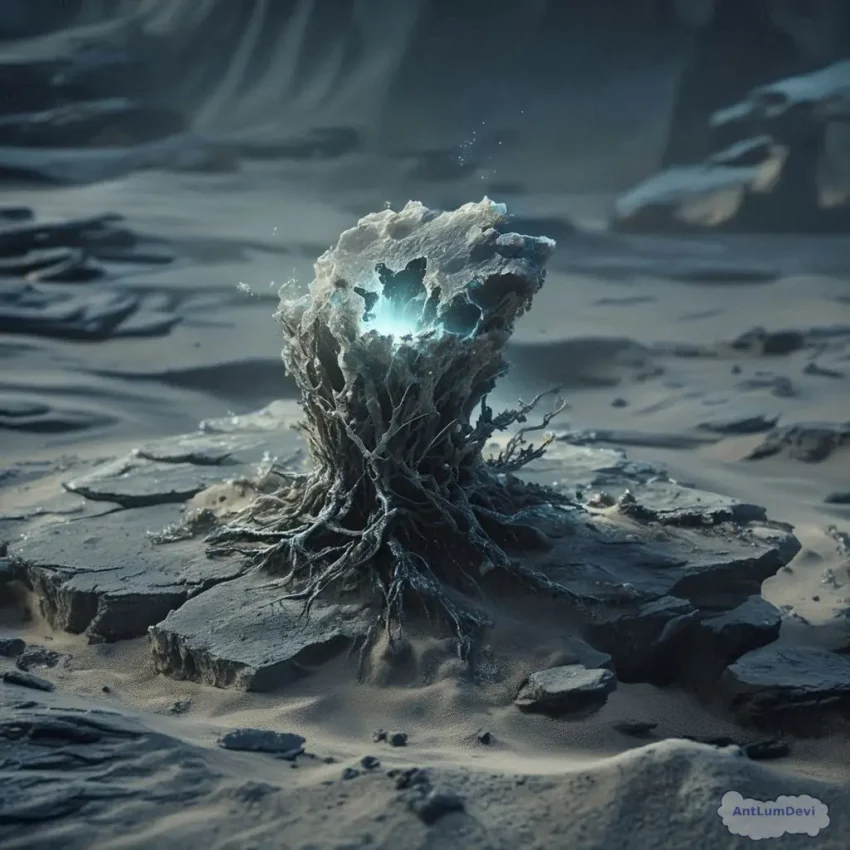
Stonebloom grows where all other plants have withdrawn. It is a quiet, mineral organism rooted directly into the rock, sustained not by light or water but by pressure and the slow movement of the earth. Its bloom resembles a delicate crack in stone and appears only when the resonance of the ground shifts.
Stonebloom is rare, solitary, and nearly indestructible. It emerges in places where the world is changing — along tectonic fractures, in abandoned caverns, and in landscapes long forsaken by other flora.
“In places where all other plants pulled up their roots and left, the Stonebloom remains.”

Bipilon’s Note
“When even the rock starts blooming, it’s time to go home.”
„You inquire, Verdana Lux Datlesk responds…“
What is Stonebloom and how does it survive?
Stonebloom is a rare, mineral organism that grows directly from rock in forsaken landscapes. Unlike typical plants, it does not rely on light or water; instead, it is sustained by geological pressure and the slow, rhythmic movement of the earth.
Where can Stonebloom be found and when does it bloom?
Stonebloom emerges in solitary locations where the world is changing, such as tectonic fractures and abandoned caverns. Its bloom, which resembles a delicate crack in the stone, appears only when there is a shift in the ground’s resonance.